Emmanuel’s History
In 1752-1753, Pottsgrove was laid out by John Potts on a tract of 990 acres, which he had purchased from Samuel McCall on September 8, 1752. The original layout stretched from York to Charlotte Street and from the Schuylkill River to Beech Street. The little town was incorporated as a borough on February 6, 1815.
In 1752, John Potts gave the Germans a lot for church and burial purposes reaching from Chestnut to Walnut Street, extended east from Hanover Street. A log church was erected on this lot by the Germans at the spot where Emmanuel now stands, but the exact date is unknown. Dates on tombstones in the cemetery indicate that burials were made as early as 1765; however, it is believed that burials were made here at an even earlier date.
The archives of the old Ministerium of Pennsylvania Synod, located in the Lutheran Seminary of Philadelphia, sets 1771 as the date in which this group of Lutherans was accepted as an organized church. The oldest parish records in the Emmanuel archives were written in German script and are the accounts of the baptisms, confirmations, and communions in 1777.
The congregation was growing so rapidly that the old Log Church could no longer accommodate all of the people and a new building was planned. It was built in 1795 on the opposite corner of the lot from the old Log Church. About 195,000 bricks, costing about $6.00 per thousand, were used in the construction. When completed, the total cost of the new church was about $6,000.
In April of 1834, the congregation and vestry met after the service for the purpose of securing regular services in English. At the meeting, it was decided that those members who wished to have English services shall retain and pay their own minister, form a second vestry, make their own collections, and appoint a treasurer. The following month, an English Lutheran pastor was called and a vestry chosen.
Desire for an English Lutheran Church building continued to grow and in February of 1859, the members of the English congregation voted to build one opposite the Brick Church on the corner of Hanover and Chestnut Streets. The charter of “The English Evangelical Lutheran Church of the Transfiguration” was approved by the congregation in October of 1859, and granted by the court in March of 1860.
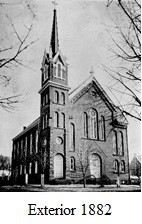
The rapid increase in membership experienced by the German Lutheran congregation strengthened the desire to have more frequent services and a building of their own. In the fall of 1870, they entered into negations with the German Reformed congregation in hopes to divide the Union shared between the two. In May of 1871, the congregation sold their interest in the Brick Church to the German Reformed congregation with the property between Chestnut and Walnut Streets divided equally between the two congregations.
The church’s first pipe organ was built and installed in 1885 by A. B. Felgemaker Company of Erie, Pennsylvania. In addition to the work required to prepare space for the organ, the exterior woodwork was repainted and additional gas lighting fixtures were installed in the sanctuary.
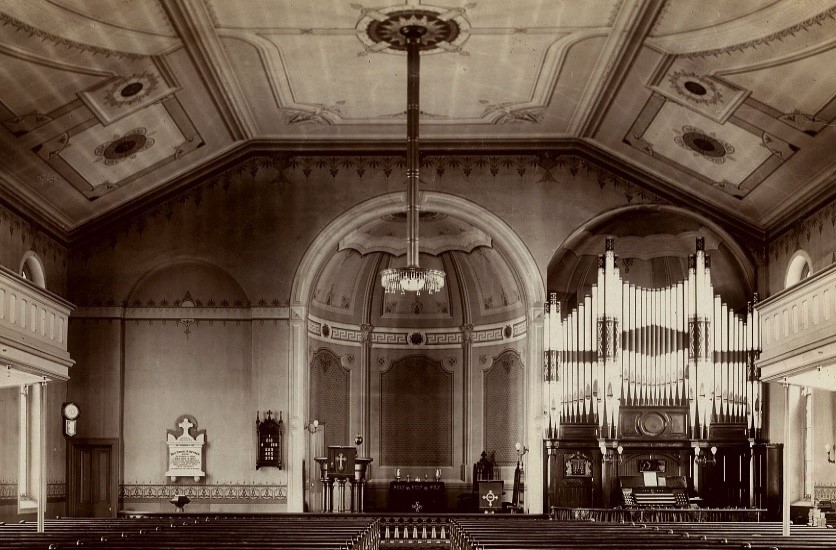
In 1903, an annex to the church was constructed to provide more adequate room for the Primary department of the Sunday School. In addition to classes for children, several adult classes were formed in the years that followed: the Normal Class in 1912, the Brotherhood Bible Class in 1927 and the Young Men’s Bible Class in 1932.
In the winter of 1912, extensive renovations were made to the church including the addition of a porch over the entrance on Hanover Street and the replacement of the enclosed stairs with open stairs with a handrail. Also changed was the style of architecture in the sanctuary from Romanesque to English Gothic. The ceilings were vaulted, the side balconies were removed, and clustered columns were added. It was during these renovations that Philadelphia artisan Nicola D’Ascenzo designed, built and installed the stained-glass windows which tell the story of the life of Christ. The large west window depicts the Ascension – the culmination of the stories told in the aisle widows.
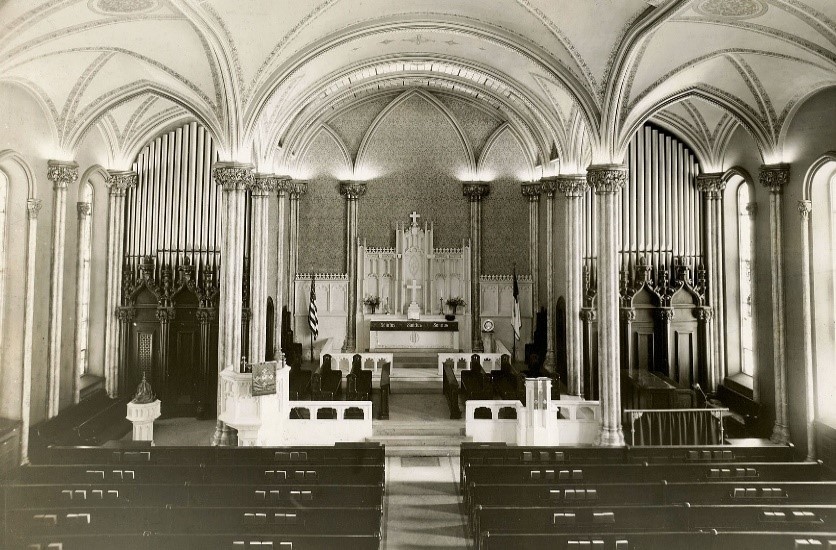
The organ was relocated as part of this major renovation by C. S. Haskell of Philadelphia. The altar, reredos, pulpit, lectern, baptismal font, and communion rail were all new and carved from Caen stone imported from Normandy in the southern part of France. Six elaborate services to dedicate the renovated church building were held on Pentecost Sunday, May 26, 1912.
Due to increasing enrollment in the Sunday School, the annex erected in 1903 was demolished and replaced with the Memorial Sunday School Building in 1929. It was dedicated on November 16, 1930. The name “Memorial Sunday School Building” was chosen in memory of those persons whose bodies were buried in the footprint of the new building and whose remains were carefully re-interred under the Main Sunday School Room. Two plaques containing each of their names hang in the Foyer of this building in remembrance of them.
In 1948, significant improvements were made within the church sanctuary with the chancel, nave and narthex being redecorated. Part of this project was the installation of a new pipe organ built by the M. P. Möller Organ Company of Hagerstown, Maryland.
On Sunday, February 26, 1956, ground was broken for the construction of an addition to the Memorial Sunday School Building containing spacious classrooms, restrooms and closets. In addition, a stage was built in the Main Sunday School Room, the kitchen was relocated, a stair tower and elevator were added to access the sanctuary, and the sanctuary was air conditioned. The Dedication Service was held on June 16, 1957.
1971 marked the Two Hundredth Anniversary of the founding of Emmanuel’s congregation. The celebration included a visit from Rev. W. Carter Merbreier (the beloved actor who stared in the hit television series Captain Noah and His Magical Ark), special worship services and a dinner held in the Sunnybrook Ballroom with 600 in attendance. At the conclusion of the worship service on May 2, a time capsule was buried in the front lawn.
In 1982, the joint purchase and demolition of the former Pottstown High School by Emmanuel and Zion’s United Church of Christ made way for a new parking lot. It was dedicated on May 25, 1985 and included the construction of a porte-cochère (covered drive-thru) at the entrance to the Sunday School Building.
In 1989, the sanctuary again underwent renovations. This included the repair and repainting of the walls and ceilings, refinishing all of the natural woodwork and new carpeting. At the completion of this work, the Schantz Pipe Organ Company of Orrville, Ohio, installed a new pipe organ which retained pipework from the 1949 Möller organ and the 1885 Felgemaker organ. Dedication for both projects took place on Sunday, October 23, 1989.
The year 1999 saw the relocation of the church offices to the existing classroom adjacent to the Sunday School Building entrance. The suite featured a spacious office for the staff as well as two new toilet rooms, one of which being handicapped accessible.
By the beginning of the new century, Transfiguration Lutheran Church had experienced such a decline in membership and attendance that she was struggling to meet her financial obligations. Meetings between Transfiguration and Emmanuel took place to discuss the possibility of sharing ministry and on June 26, 2005, the congregations met for the final worship service in the English Evangelical Lutheran Church of the Transfiguration. Following the “Litany for Merger,” the now-united congregation processed across the street to Emmanuel. Leaders from Transfiguration carried the Transfiguration parish register, the bowl from the baptismal font, the paten and chalice from the altar, and the Bible from the pulpit. Once inside Emmanuel, the service concluded with a blessing of these items and the singing of the hymn “Blest Be the Tie That Binds.”
During the summers of 2011–2013, Emmanuel was the sponsor of a Little League Team for developmentally challenged children. The team, “Edith’s Angels,” provided these young people with a safe and supportive atmosphere in which to play baseball. At the end of the season, a picnic was held – complete with an awards ceremony.
Emmanuel has a long-standing partnership with two area organizations to serve meals to the needy in the Pottstown community from her kitchen. The Pottstown Cluster of Religious Organizations provides free meals at various church buildings in the area, prepared and served by members of the host church. Pottstown-based God’s Kitchen coordinates the Monday evening meal which is provided by congregations throughout Montgomery County and served at Emmanuel.

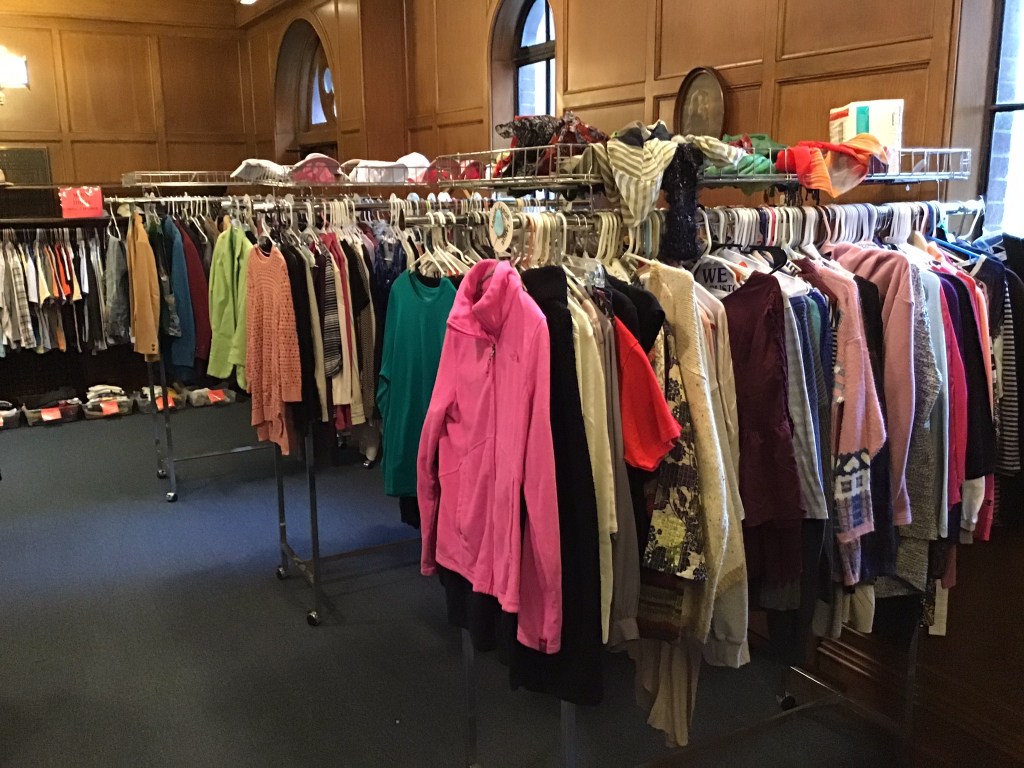
September of 2020 saw the birth of “Emmanuel’s Closet” – a ministry that provides free clothing, shoes, coats, and personal care items to the less fortunate in the community. Housed in the Hanover Street foyer, the closet is open five days a week.
In 2021, the “German and English Evangelical Lutheran Emmanuel’s Church” celebrated its Two Hundred Fiftieth Anniversary. Exactly 50 years after its placement on May 2, 1971, the time capsule was unearthed and its contents revealed on May 2, 2021 following the worship service.
In May of 2024, Emmanuel called The Reverend Dr. Carl W. Filer to serve as her ninth called pastor.
God has truly blessed this small group of Germans who settled in Pottsgrove, more than 250 years ago. His spirit has raised up committed laymen and women who have toiled alongside their pastors so that all might be the recipients of their legacy. May this people who are known as Emmanuel Evangelical Lutheran Church of Pottstown continue to be faithful to God’s calling and to the mission of his Church so that others yet unborn may give thanks for their work and witness. To God be all the Glory.
 Emmanuel Evangelical Lutheran Church